Tumwata Village Riverwalk in Oregon City: What’s Next
August 13, 2026
August 13, 2026
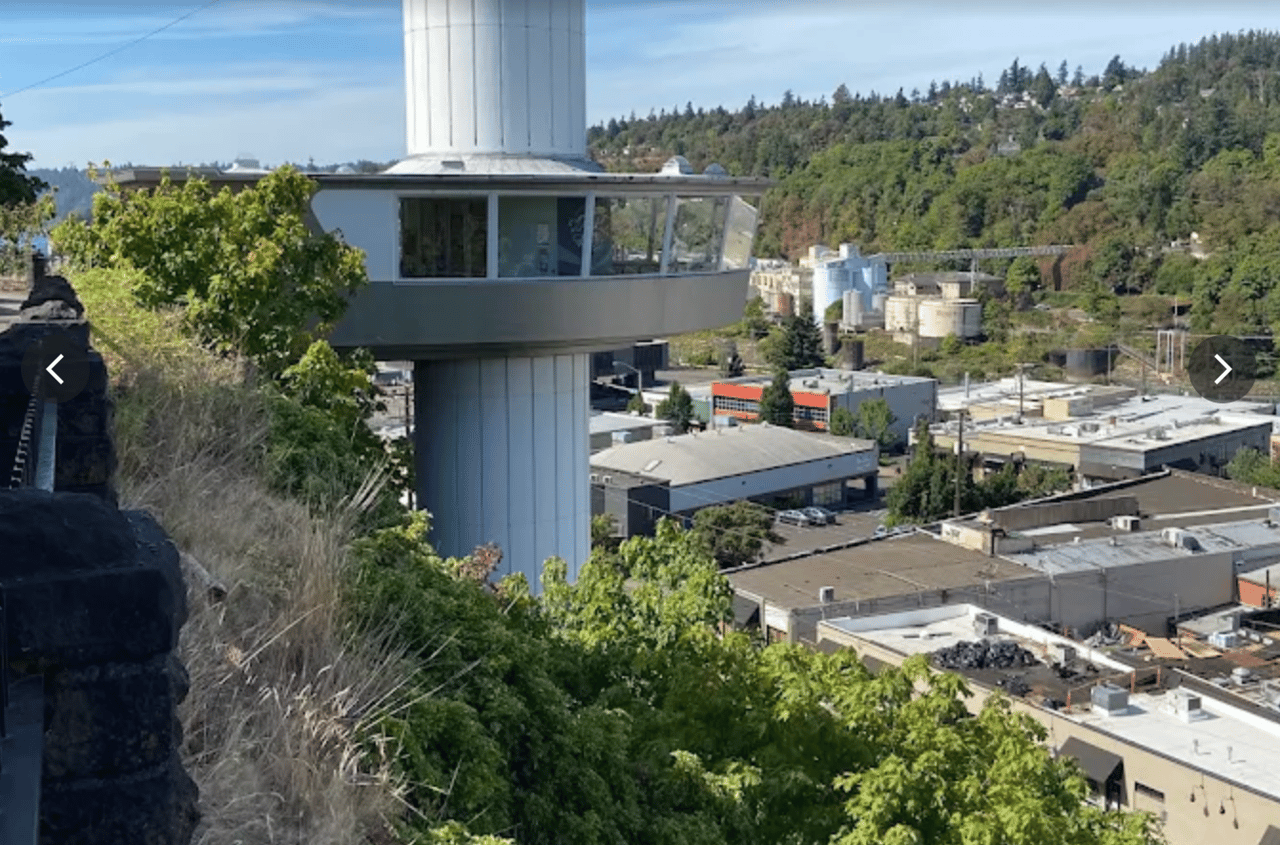
Ride the Municipal Elevator on any clear evening this month and the doors open onto the same panorama they always have: the river bending south, the Arch Bridge, and Willamette Falls churning below the bluff. If you've made this trip before, the choreography feels automatic. Step in at the tunnel under the railroad tracks, wait for the doors, walk out onto the promenade. What's different this year isn't the choreography. It's what you're looking at when you get there.
For more than a decade, the ground directly below the observation deck has been the one part of the view that never changed. A fenced, mostly empty industrial site sat between the promenade and the river while everything around it kept moving. That changed this spring, and the part of the story most people haven't caught up on happened just a few weeks ago.
The Municipal Elevator itself is worth pausing on before getting to what's below it. The Oregon City Municipal Elevator is a 130-foot elevator which connects two neighborhoods in Oregon City. It's the only outdoor municipal elevator in the U.S. The current structure was completed in 1954 to 1955 and added to the National Register of Historic Places in 2014. Since the pandemic, it has operated self-service, rather than with the operator it once had, so the walk up is now something residents read on their own rather than with a guide narrating what they're seeing.
At the top, the elevator connects to a 7.8-acre linear park on the bluff above downtown built in 1937 as a Works Progress Administration project. From there you can head north toward the McLoughlin House or south along the bluff, where a pedestrian overpass carries walkers across McLoughlin Boulevard to a closer view of the falls. That's the route. It hasn't changed. What sat at the base of that route, visible from nearly every point on the promenade, was the old Blue Heron paper mill: fenced, partly demolished, and largely frozen in place since the mill closed in 2011.
As OPB reported, hopes to restore public access to the falls began taking shape in 2011 with the mill's closure and the formation of the Willamette Falls Legacy Project, a four-party effort between the city, county, state, and Metro. The Confederated Tribes of Grand Ronde purchased the 23-acre property on August 15, 2019, and began demolition of the old mill buildings on September 2, 2021. The Grand Ronde withdrew from the four-party project in 2022 and named the site tumwata village, using the Native name for the falls.
A new milestone came on May 28, 2026, when tribal leaders, Governor Tina Kotek, and Oregon City Mayor Denyse McGriff gathered on the property for a formal groundbreaking. With the old mill largely dismantled, the Grand Ronde broke ground on infrastructure for tumwata village that day. As OPB reported, Kotek said:
"This is about healing and this is about restoration."
The first block of construction includes two buildings, a multi-use space with retail, office, and event space, and an apartment building, with actual construction of those buildings still a year or two out. Once that block is finished, the project moves south through the rest of the property, eventually adding more roads, buildings, retail, cultural space, gathering areas, and a riverwalk to the falls.
The groundbreaking marked an important milestone, but the site is not as far along as the ceremony alone might suggest.
The infrastructure work happening on site right now, curbs, sewer and water lines, grading, isn't the part that will change the view from the promenade. The part that actually reconnects the bluff to the river is the riverwalk itself, and that piece just moved forward separately, and more recently, than the groundbreaking.
In early August, the Grand Ronde and the City of Oregon City selected Maul Foster & Alongi as lead design consultant for the next segment of the public riverfront, the riverwalk at tumwata village. The firm is beginning detailed design, engineering, and permitting for that segment immediately. They were chosen through a competitive process for their permitting experience and their work on culturally informed design. The work is backed by real money already in hand: a $12.5 million allocation from Oregon State Parks is intended to fund the bulk of design and construction for what the project calls riverwalk block two.
That approval didn't happen at a podium. It happened at a Grand Ronde legislative committee meeting on July 28, where a tribal community development manager laid out the funding mechanics. She described it as onboarding a consultant team for the next body of work, building on an intergovernmental agreement worked out with the city back in April. No governor, no ribbon. Just the paperwork that determines whether the riverwalk actually gets built on schedule.
That's the piece worth understanding if you're the one riding the elevator: the site below you is running two clocks at once. One clock is visible, slow, and physical, block one's buildings won't rise for another year or two. The other clock is invisible, faster, and financial, the riverwalk design that will eventually let you walk down from the promenade to the water's edge just moved from a committee vote to a signed engineering contract in about a week.
A rough timeline, if you're trying to place where things stand:
If you want to see the difference for yourself, the routine hasn't changed, only what you're looking for has. The elevator runs Monday through Saturday from 7 a.m. to 7 p.m. and Sunday from 10 a.m. to 7 p.m., and it's still free. From the observation deck, look for cleared grading and utility work rather than framed buildings, that's the infrastructure phase, and it's the part that has to finish before block one's two buildings go vertical. The riverwalk itself, the part that will eventually connect the base of the bluff to the river's edge, exists right now only as a design contract. There's nothing to see there yet, and there won't be for a while. That's not a stall. It's just where a $12.5 million public project sits days into a newly signed engineering contract.
If you'd rather walk than ride, the Grand Staircase shares the same upper and lower landings as the elevator, winding up the bluff past a small constructed waterfall on Singer Creek along the way. Either route puts you at the same vantage point over the tumwata site.
The next visible milestone on the promenade side is block one's two buildings, and the tribe's own timeline puts that a year or two out from the May groundbreaking, so sometime in 2027 or 2028 at the earliest. The riverwalk itself will lag behind that, since its design work only started this month. If you're the kind of resident who takes this walk regularly, the honest read for the next year is: watch the grading finish, watch for permit filings, and don't expect to see the water-facing side of the site change yet. The story right now is in the paperwork, not the skyline.
That's often how the most consequential local changes work. The photogenic moment is the groundbreaking with the governor and the tribal chairwoman. The moment that actually determines whether a project meets its timeline is a legislative committee approving a professional services agreement on a Tuesday afternoon. Both happened this year, about two months apart.
If you're weighing a move into Oregon City and want to understand how a project like this affects a neighborhood's long-term character, not just this year's view, that's the kind of question we like to sit down and talk through. Wings NW Real Estate works this market from the ground up, literally, in this case. Let's navigate your next move. Schedule a strategy call whenever you're ready.
A Northwest Tradition Worth Discovering

Camas Plein Air

work with us
Ready to love where you might land next? Contact us!
19363 Willamette Dr #161 West Linn OR 97068 701 NE 136th Ave, 2nd Floor Vancouver, WA 98684