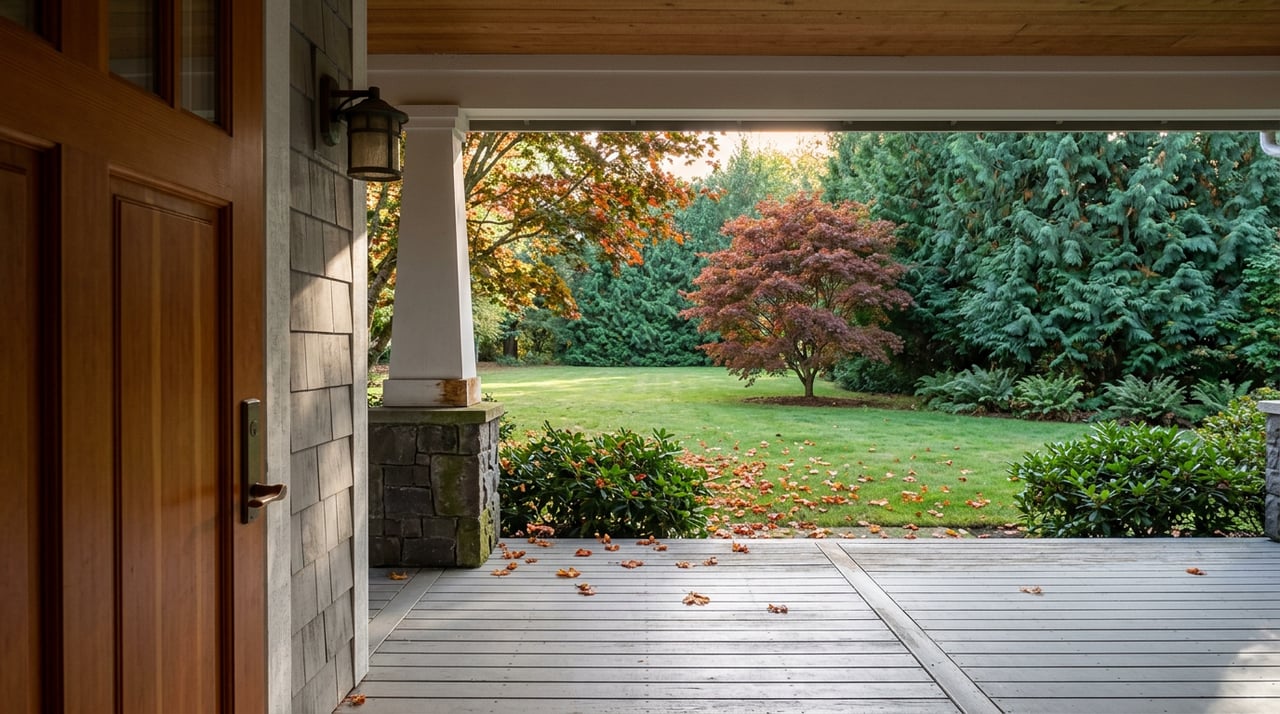
Downtown Milwaukie Fall Weekend: The Market & Beyond
September 17, 2026
September 17, 2026
For twenty-seven years, the rhythm of downtown Milwaukie has run on a switch. Every May, the corner of Main and Harrison fills with tents, produce boxes, and the smell of kettle corn. Every October, the switch flips off, and the blocks around it go quiet until spring comes back around. That is the pattern the Milwaukie Sunday Farmers Market has set since it started with seven vendors in 1999, and it is the pattern that has defined how this town uses its own downtown for a generation.
This year the switch does not fully flip. Fifty yards from the market's usual footprint, a three-story food cart pod opened in February with fire pits, a rooftop bar, and a name built around the year Milwaukie itself was founded. It didn't replace the market. It sits next to it, on land the market's own regulars walk past every Sunday, and it stays open through the months the market doesn't. That changes what "the market season ending" actually means for anyone who lives here.
The Milwaukie Sunday Farmers Market isn't a seasonal afterthought. It's the longest-running Sunday market in the Portland metro, and in November 2012 The Oregonian named it the region's best small farmers market. It now draws close to 80 vendors a week, more than ten times the size it opened at, selling everything from Sun Love Farms produce grown minutes away in Oregon City to Rose City Pepperheads' hot sauces and Jacobs Creamery cheese.
But the market has always run on a fixed calendar: first Sunday in May through the last Sunday in October, 9:30 to 2:00, and nothing in between. That structure is intentional. It keeps the market's identity tied to harvest season and keeps overhead low for vendors who don't want a year-round commitment. For downtown Milwaukie, though, it has also meant that the town's single biggest weekly draw simply stops existing for five months a year. Anyone who has walked Main Street in January knows the difference. The tents are gone, and so is most of the foot traffic that follows them.
The 1847 Food Park opened to the public on February 5, 2026, on the former site of the Peake Funeral Chapel at 1925 SE Scott Street, directly adjacent to City Hall and close enough to the market grounds that regulars can walk between the two without crossing McLoughlin. It sits within a block of pFriem's Milwaukie tasting room, which itself operates out of the old fire station wing of the historic City Hall building.
The name is a small piece of local history doing double duty as branding. Milwaukie was founded in 1847 by Lot Whitcomb, and the food park's organizers built the number into everything from the address plaque to the site's public materials.
What makes the food park a genuine successor to the market's summer draw, rather than just another cart pod, is what it's built to do in the off months. The three-story structure includes a rooftop space called the Sky Bar, indoor and outdoor seating, fire pits for the wet months, and what its own organizers describe as year-round community-centered programming. Up to seventeen carts operate on-site, including a rotating lineup that has featured:
A handful of carts rotate through on a weekly basis, so the lineup shifts even for people who visit often.
Here's the comparison that matters if you've lived here through a few market cycles already:
| Milwaukie Sunday Farmers Market | 1847 Food Park | |
|---|---|---|
| Season | First Sunday in May through last Sunday in October | Year-round |
| Location | SE Main St & Harrison St | 1925 SE Scott St, one block over |
| Weather plan | Outdoor tents, no cover | Indoor seating plus fire pits |
| What closes it | The calendar | Nothing scheduled |
For every prior season, the second column of that table was mostly empty. Downtown didn't have a cold-weather equivalent to the market's draw. Now it does, and it sits close enough that the two aren't competing for the same Sunday, they're extending the same block's usefulness across a longer stretch of the year.
Right now, both anchors are running at once, and the calendar is stacking a few other fixtures into the same stretch before the market tents come down on October 25.
Downtown Milwaukie's First Friday continues on its usual monthly schedule, with dates on the books for September 4 and October 2, drawing local shops and the food park itself into a coordinated evening rather than a market-day event. The city's Sustainability Fair lands on September 19, staged right at the market's own grounds on SE Main Street, folding a civic event into the same footprint that produce stands occupy every other week of the season.
None of this is unusual programming for Milwaukie. What's unusual is that it's happening in the same six-week window as the market's final Sundays, which means the corner of Main and Harrison is busier right now, in mid-September, than it will be at almost any other point this year, market included.
There's a second seasonal clock running at the same time, and it has nothing to do with vendors or carts. From Spring Park, in the Island Station neighborhood, a boardwalk trail through oak forest and wetland leads to a seasonal land bridge that connects to Elk Rock Island. It only appears when river levels are low, typically from late spring through fall, and it closes on its own once autumn rain raises the Willamette.
Walkers who know the route treat it as one of downtown Milwaukie's better-kept features precisely because it isn't permanent. Spring Park opened in 2015 after nearly two decades of planning, and its trail, described by regular local walkers as one of the more rewarding short routes in the area, connects to Milwaukie Bay Park and the northern end of the Trolley Trail, the paved 5.5-mile path that runs down to Gladstone. Right now, in September, the bridge is almost certainly still passable. By the time the market closes for the season, it may not be.
For years, the last Sunday in October marked the point where downtown Milwaukie went quiet until the following May. This year, that isn't quite true. The food park keeps its carts running, the Sky Bar stays open through the wet months, and First Friday keeps its monthly slot on the downtown calendar regardless of what the market is doing.
That doesn't mean downtown will feel exactly the same in December as it does today. The market's specific texture, the produce boxes, the flower bouquets, the live music sponsored by groups like the Portland Waldorf School and pFriem, doesn't have a direct substitute. But the assumption that downtown simply shuts off when the tents leave no longer holds the way it used to. If you've built your fall and winter routine around the idea that Main Street goes dark after October, this is the year to test that assumption against what's actually fifty yards away.
We spend a lot of time in this town watching how its small blocks change, because those changes tend to say more about where Milwaukie is heading than any single listing does. If you're curious what a shift like this means for property values along Main Street or for how buyers are starting to think about downtown-adjacent homes, that's a conversation worth having before the next season turns over. Wings NW Real Estate works this market and the neighborhoods around it every week. Let's navigate your next move, schedule a strategy call.

Camas Plein Air
work with us
Ready to love where you might land next? Contact us!

19363 Willamette Dr #161 West Linn OR 97068 701 NE 136th Ave, 2nd Floor Vancouver, WA 98684